
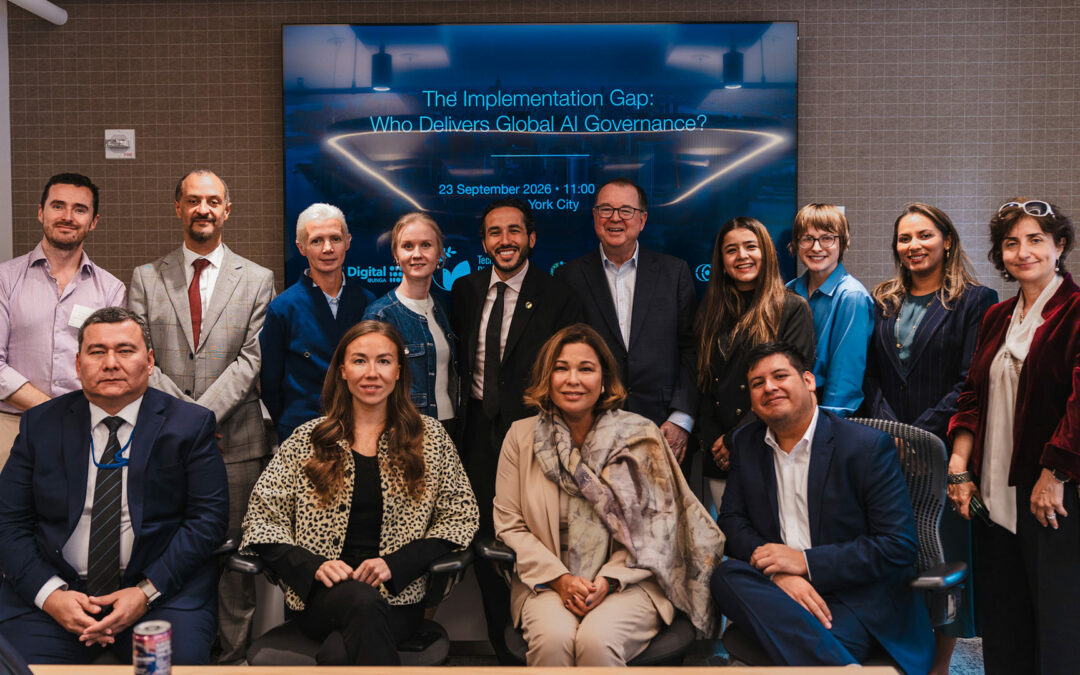
New York, September 2026. During the High-Level Week of the 81st session of the United Nations General Assembly, the Tech Diplomacy Global Institute convened two closed-door roundtables in Midtown Manhattan, both part of the official Digital@UNGA 2026 Affiliate Sessions programme. Held on 23 and 24 September and chaired by our Founder-President Ayumi Moore Aoki, the sessions took up two questions that sit beneath every commitment made at the United Nations on artificial intelligence: who will deliver global AI governance, and what do states actually control?
Each session gathered around twenty participants at a single table under the Chatham House Rule. Around it sat Tech Ambassadors or equivalent senior tech diplomats, including digital, cyber and AI ambassadors and special envoys for technology, alongside senior officials from Permanent Missions and international organizations, and leaders from industry, research and civil society. There were no panels and no audience. The format was chosen to allow the kind of candour that governments rarely have room for in public.
Who Delivers Global AI Governance?
The first roundtable, “The Implementation Gap: Who Delivers Global AI Governance?”, was co-organized with the Ministry of Foreign Affairs of the Republic of Uzbekistan and Mia AI, and moderated by Dr. Sïmon Saneback, Chief Operating Officer of TDGI.
The session started from a paradox. The world has never had more principles, declarations and frameworks on artificial intelligence, and two months after the first session of the Global Dialogue on AI Governance in Geneva, the multilateral architecture continues to grow. The capacity to apply these commitments at home has not kept pace. Agreements are negotiated by foreign ministries and implemented, when they are implemented, by institutions that were often not part of the negotiation.
Participants focused on the single binding constraint on delivering what governments have signed: who owns the AI file inside government, what must be built nationally before international commitments can take effect, and which appointment, mandate or skill should come first. The table closed by agreeing three questions, which were handed to the Ministry of Foreign Affairs of Uzbekistan to shape the Tech Diplomacy Asia Symposium in Tashkent on 14 October.
What Do States Actually Control?
The following morning, the Institute convened “Sovereign AI: What Do States Actually Control?” with the Ministry of Foreign Affairs of Estonia and Mia AI. The discussion was structured around the Diplomatic Digital Stack developed by Prof. Corneliu Bjola of the University of Oxford, which treats artificial intelligence as a series of layers, from energy and raw materials to data centres, models and applications.
Participants worked from a shared definition. Sovereignty is the capacity to make meaningful choices about which dependencies to accept, together with the credible ability to switch. No country holds every layer of the stack, and self-sufficiency is within reach of none. Several conclusions emerged from the exchange:
• A data centre on national soil is not necessarily under national control. Where governments do not define sovereignty precisely, they risk acquiring a hollow version of it.
• The physical layer is where the gap between ambition and control is widest. Concentration in chips, data centres and energy explains this more than technical difficulty does, while open-weight models make the gap at the model layer smaller than public debate suggests.
• Middle powers and smaller states can choose a niche, by identifying the choke points where they hold real leverage and being clear about the role they intend to play in the value chain.
• Existing law already gives states meaningful control over how AI is used. The applied layer, what is actually done with the models, is missing from most sovereignty frameworks.
• Trust depends on evaluation. Institutions will not place AI in sensitive processes until they know where it fails, and the evaluation effort required far exceeds what exists today.
The words participants returned to most often were trust, transparency, accountability and fair taxation.
From New York to Tashkent and Paris
The two roundtables were designed as one programme. The first diagnosed the distance between commitment and delivery; the second examined sovereignty layer by layer, where control is actually won or lost. Participants receive a non-attributed chair’s summary of each session. Their findings informed the Tech Diplomacy Asia Symposium in Tashkent and will feed into the Tech Diplomacy Global Assembly in Paris on 11 December 2026.
The Tech Diplomacy Global Institute thanks its co-organizers, the Ministry of Foreign Affairs of the Republic of Uzbekistan and its Embassy in Washington, the Ministry of Foreign Affairs of Estonia, and Mia AI and its co-founder and CEO Janna Salokangas, and every participant for the candour of the discussion.