“Tech Diplomacy as Statecraft: Building Trust in a Fragmented Era”
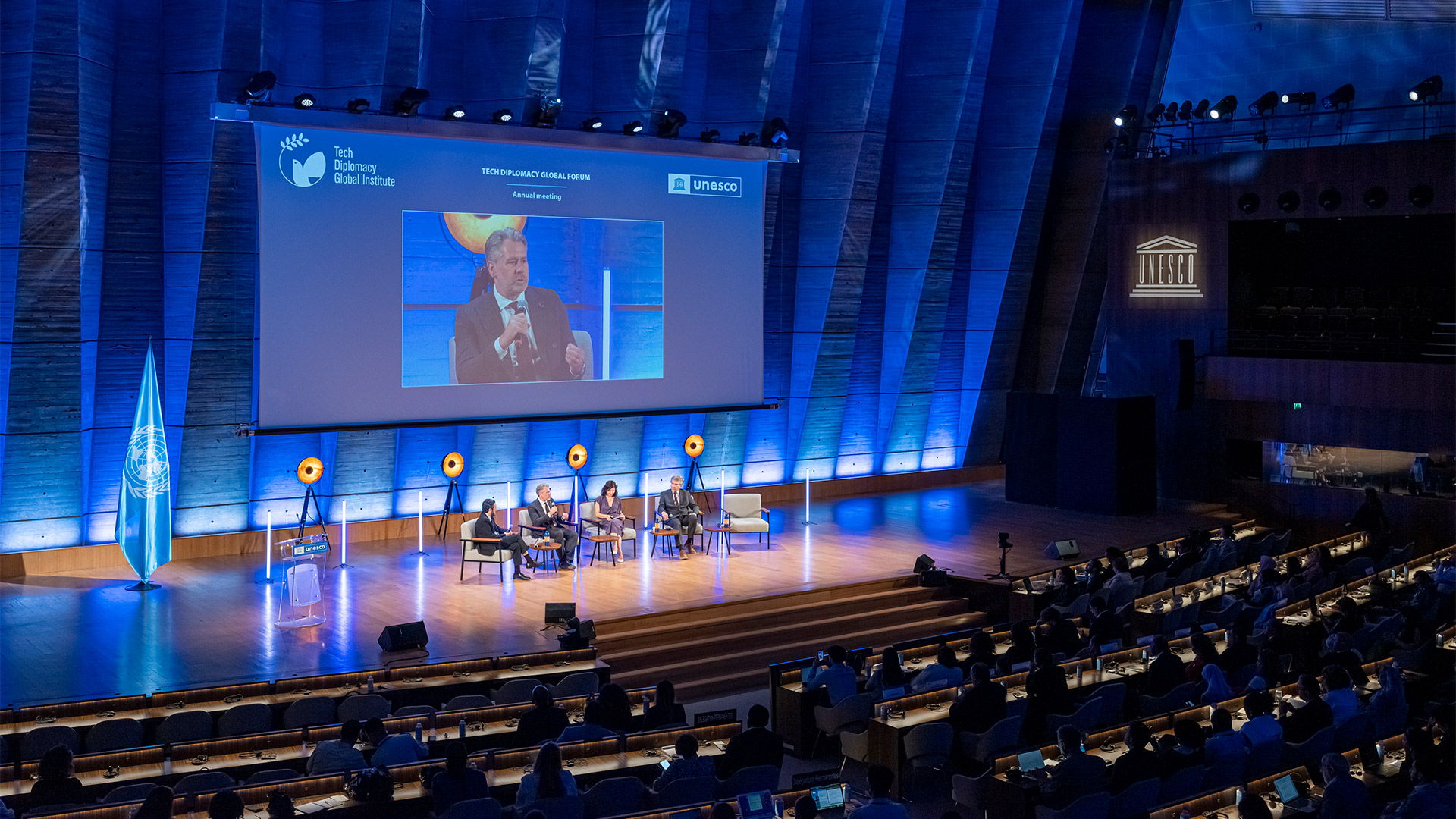
In an increasingly fragmented global landscape, the Tech Diplomacy Global Forum 2026 brings together world leaders, policymakers, technologists, and civil society to forge new pathways for international cooperation. Hosted at the historic UNESCO Headquarters in Paris, this landmark gathering will address the critical challenges of building trust across borders, sectors, and communities in the digital age.

Key themes

Digital Sovereignty and Global Governance

AI and Ethics in International Relations

Cybersecurity and International Cooperation

Bridging the Digital and Gender Divide
Tech Diplomacy Global Forum 2026
“Building Trust in a Fragmented Era”
Thursday 2 July 2026 – Paris, La Maison de L’UNESCO, Room I
125 avenue de Suffren, 75007 Paris
The Program
09:00 – 09:45:
Registration and Networking Coffee
09:55 – 10:15:
Opening Ceremony
Codes Morpho
Performance by artist Céline Shen in collaboration with ArtVerse gallery
with the performers Tomo Muranaka, Zlata Rosen and the robot Nao in partnership with Maxtronics Robotics
Opening Keynotes
Dr. Abou Amani, Assistant Director-General for Sciences a.i., UNESCO
Ayumi Moore Aoki, Founder-President, Tech Diplomacy Global Institute (TDGI)
10:15 – 10:45:
Tech Diplomacy as Statecraft: From Exclusive to Inclusive Policy
A high-level conversation on why technology can no longer be treated as a narrow, sectoral issue, and how tech diplomacy can become a genuine engine for fulfilling development goals at both the national and international level.
H.E. Gobind Singh Deo, Minister of Digital, Malaysia
Dr. Tawfik Jelassi, Chair of the Supervisory Board, Tech Diplomacy Global Institute
Moderator: Salma Karim, Head of Human Capital and Innovation Department, Digital Development Agency, Morocco
10:45 – 11:45:
Equity in practice: The fundamentals of responsible tech diplomacy
This panel brings together leading voices from science diplomacy, AI governance, and Latin American foreign policy to examine how governments can steward digital transformation responsibly, protecting rights, fostering innovation, and closing the divides that risk leaving entire regions behind.
Prof. Sonja Schmer-Galunder, Professor of AI Ethics at University of Florida
Casper Klynge, Vice President, Head of Gov. Affairs, EMEA, Zscaler. World’s first Tech Ambassador (Denmark)
Dr. Rachel Adams, CEO, Global Center on AI Governance
Prof. Corneliu Bjola, Professor of Digital Diplomacy, University of Oxford
Moderator: Sïmon Saneback, COO, Tech Diplomacy Global Institute (TDGI)
11:45 – 12:00:
Signals from the Digital Frontier
Dr. Daniel Hulme, CEO, Satalia
12:00 – 12:30:
Oxford-Style Debate
Motion: Technology Companies Now Shape Global Order as Much as States Do
A structured debate confronting one of the defining questions of our era: as a handful of technology companies amass infrastructural, informational, and economic power once reserved for sovereign states, has the balance of global influence fundamentally shifted, or does state authority still hold the final word?
Titi Akinsanmi, AI Governance & Strategy Expert
Antoine Jardin, Co-founder and Technology Director, Arlequin AI
Dr. Philippe Vogeleer, Non Executive Director, Global Partners for Digital Development
Kathryn Rose, Diplomatic Liaison for the US, Women in Tech Global
Moderator: Lora Gailly, Associate Project Officer, UNESCO
12:30 – 14:00:
12:30 – 12:40
Lunch Break
Please note, lunch will not be provided
Launching the Global 5X AI Impact Accelerator
Side announcement on main stage
14:00 – 15:00:
Meet the Tech Ambassador: Inside the New Diplomatic Role
This session brings together pioneers and practitioners of one of diplomacy’s newest roles, offering a candid, practical look at what it actually means to be a Tech Ambassador, from the first appointment in 2017 to its evolution across very different national contexts today.
H.E. Ana Maria Pesantes, Ambassador of Ecuador to France, Monaco, OCDE, UNESCO
Dr. Tobias Feakin, Managing Director, Protostar Strategy; former Tech Ambassador, Australia
H.E. Helen Popp, Ambassador-at-Large for Cyber Diplomacy, Ministry of Foreign Affairs of Estonia
Henri Verdier, Director General, Fondation INRIA
Moderator: Dr. Amal Kasry, Chief of the Basic Sciences, Engineering, Technology and Innovation Section, UNESCO.
15:00 – 15:45:
AI in foreign policy: both as an instrument and as a geopolitical force
This session will explore how AI is reshaping diplomatic practice across two dimensions: as a
data-driven toolset within diplomacy and as a geopolitical and industrial force that
diplomats must understand and navigate. Drawing on the experience of leading Tech
Ambassadors and Innovation Hubs within Ministries of Foreign Affairs, we will ask: what
does tech-informed foreign policy look like in practice, and who gets to shape it?
Martin Rauchbauer, Head of Unit, Ministry of Foreign Affairs, Austria (Former Tech Ambassador for Austria in Silicon Valley)
Hans-Christian Mangeladorf, Chief Data Scientist at the MFA Germany
Dr. Olga Cavalli, Director, South School on Internet Governance
Prof. Margaret Nyambura Ndung’u, Member, UN Digital Policy Advisory Board
Moderator: Dr. Dafna Feinholz, the Chief of Bioethics and Ethics of Science and Technology, UNESCO
15:45 – 16:45:
Digital Sovereignty for Open Societies
This session explores how governments can strengthen digital sovereignty while protecting openness, rights, public trust, and international cooperation.
Tupoutuah Baravilala, Director-General, Ministry of Policing and Communications, Fiji
Christina Steinbrecher-Pfandt, CEO Tech Diplomacy Network
Manuel Schiappa Pietra, president and CEO FreeBalance
Raul Echeberria, Executive Director of the Latin American Internet Association (ALAI)
Moderator: Sarah Al Feghali, CIO, Tech Diplomacy Global Institute (TDGI)
16:45 – 17:00:
The Tech Diplomacy Agenda: What Must Happen Next
Ayumi Moore Aoki, Founder-President, Tech Diplomacy Global Institute (TDGI)
Dr. Shaofeng Hu, Director of the Division of Ethics, Research and Technology, UNESCO
Tech Diplomacy Global Forum 2025