
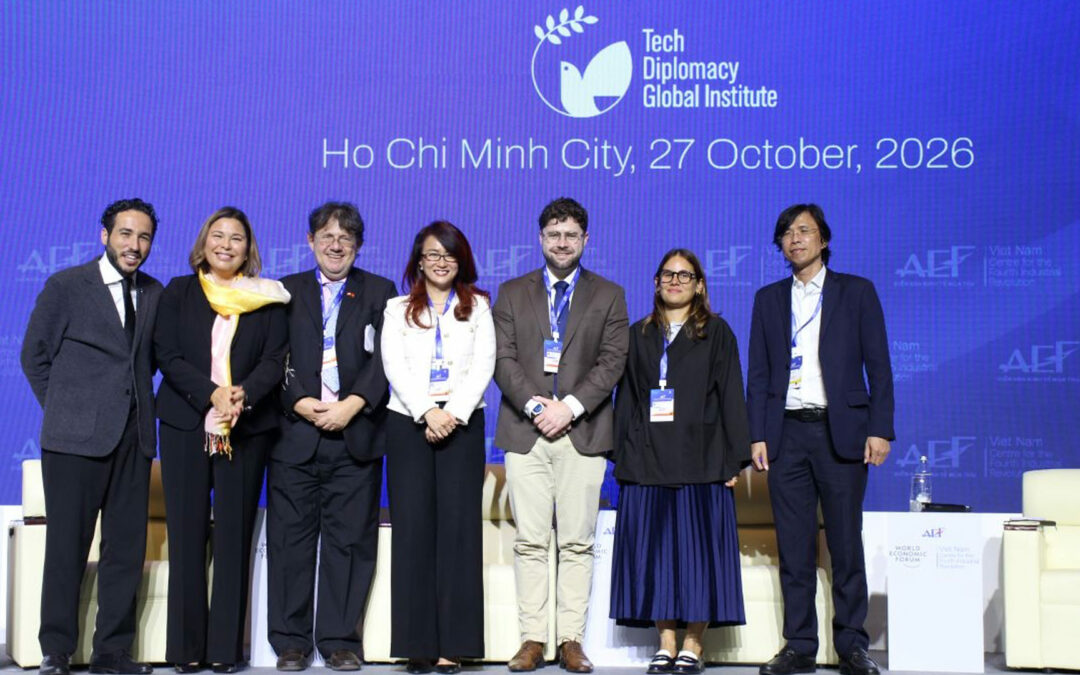
Ho Chi Minh City, October 2026. On 27 October 2026, the Tech Diplomacy Global Institute convened the session “Tech Diplomacy for Megacities: How Ho Chi Minh City Turns Technology Partnerships into Growth” at the Autumn Economic Forum 2026. Held under the theme “Convergence of New Global Growth Poles” and co-branded for the first time with the World Economic Forum, the Forum brought together government leaders, investors, international organizations and technology companies to discuss the next phase of growth for Viet Nam and its largest city.
The session started from a question that is rarely asked in diplomatic circles. When a city of around 14 million people, larger than many countries, negotiates with global technology companies over data centres, energy, data and talent, is it practising diplomacy? The panel’s answer was that it is also practising tech diplomacy, and that cities need the capacity to do it well.
Diplomacy Beyond Borders
Opening the discussion, moderator Dr. Sïmon Saneback, Chief Operating Officer of TDGI, noted that diplomacy today extends well beyond borders, trade and traditional security. It now reaches semiconductors, data, energy and the new standards that technology brings with it. Tech diplomacy is the means by which national governments, cities and companies sit down together to negotiate those standards.
Ayumi Moore Aoki, Founder-President of TDGI, set out what is at stake for a megacity. The Saigon Hi-Tech Park has attracted more than USD 14 billion in investment, and data centre projects worth billions of dollars have just been committed. At the same time, cities and nations increasingly depend on AI models, cloud infrastructure and supply chains owned by foreign technology companies rather than by governments. For Ho Chi Minh City, tech diplomacy therefore means negotiating directly with international companies on far more than land: on social impact, energy, data policy, digital sovereignty and talent. Such negotiations succeed when they rest on trust and fairness, with balanced benefits for the city and for the investor.
Building Capacity at Home
H.E. Philipp Agathonos, Ambassador of Austria to Viet Nam, argued that a smart city should be judged by how efficiently it uses its resources, from land and energy to people, finance and time, rather than by how much it digitizes. He drew on Vienna’s experience to make the case for listening to residents through urban living labs, for open-source and interoperable systems over closed proprietary solutions, and for keeping independent technical expertise inside public administrations. He also described trusted data spaces built on the idea of a “data passport”, which defines the conditions under which data can be accessed and used, and stressed that cybersecurity must be designed in from the start.
Assoc. Nguyen Anh Thi, CEO of Citares and expert at the Ho Chi Minh City Centre for the Fourth Industrial Revolution, identified the shortage of highly skilled technical workers as one of the largest constraints on Viet Nam’s ambitions. His remedy was a multi-stakeholder ecosystem connecting universities, businesses and international technology partners, built on a simple principle: a country can import technology, but the capacity to innovate has to be built at home.
Collaboration, Convergence and Capital
Dr. Sandy Chong, Head of Asia-Pacific Initiatives at the World Economic Forum, described three pillars of a successful technology ecosystem: collaboration, convergence and capital. When global technology companies enter a local market, she suggested, cities can ask them to commit to the local ecosystem through training, technology sharing and support for community projects.
Prof. Wesley Rosslyn-Smith brought the discussion back to its purpose. Digital twins and the optimization of traffic or water data are tools. The goal of a smart city is a place where daily life is easier, with less congestion and a better quality of life for its residents.
Cities as Actors in Tech Diplomacy
One conclusion ran through the session. Cities have become actors in tech diplomacy in their own right, and they need people who understand both technology and diplomacy. Helping the public and private sectors become bilingual in technology and diplomacy is at the heart of the Institute’s work, and the perspective of megacities will inform the discussions of the Tech Diplomacy Global Assembly in Paris on 11 December 2026.
The Tech Diplomacy Global Institute thanks the Ho Chi Minh City People’s Committee, the Ho Chi Minh City Centre for the Fourth Industrial Revolution and the organizers of the Autumn Economic Forum 2026 for their invitation, the World Economic Forum, and all speakers for a rich exchange. Read the coverage of the session in Thế giới và Việt Nam here.