
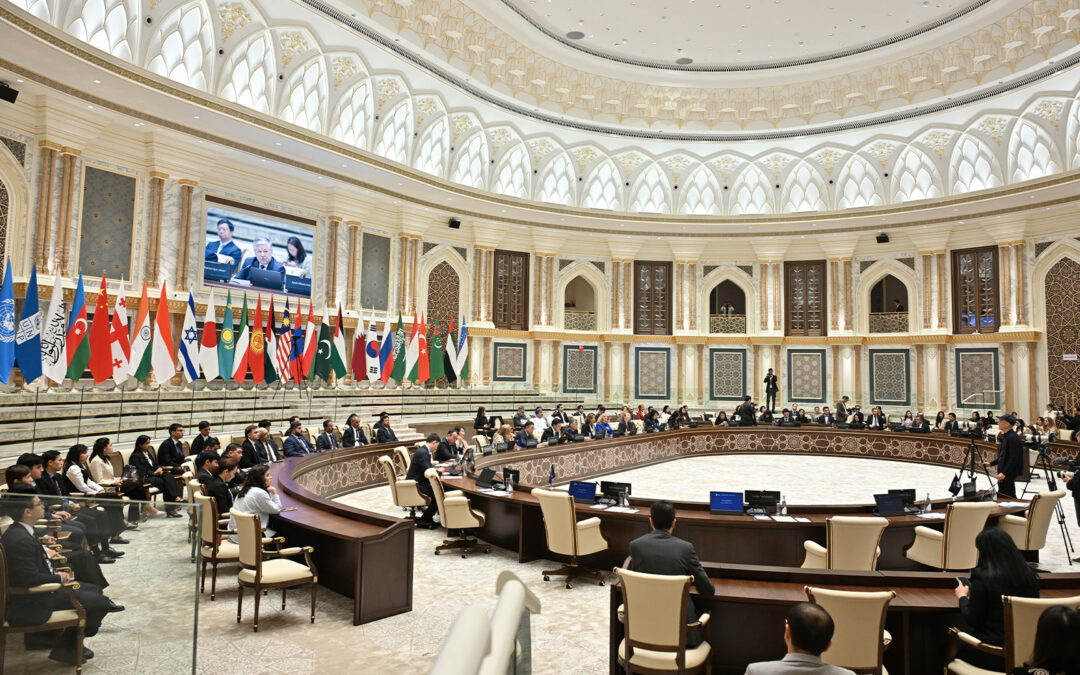
Tashkent, October 2026. On 14 October 2026, the Tech Diplomacy Global Institute and the Ministry of Foreign Affairs of the Republic of Uzbekistan convened the Tech Diplomacy Asia Symposium at the Center of Islamic Civilization in Uzbekistan. One year after the adoption of the Samarkand Declaration on Tech Diplomacy alongside the 43rd session of the UNESCO General Conference, the Symposium asked what has changed since Samarkand, and what each institution is now ready to do.
The setting carried its own meaning. For centuries, Central Asia was a crossroads where science, knowledge and trade moved between civilizations. The Symposium gathered in that spirit to ask how the region can play a similar role in an age when technology shapes how nations compete, cooperate and protect their citizens.
A Regional Table With Global Reach
The Symposium brought together ambassadors and representatives of the diplomatic missions of Afghanistan, Azerbaijan, Georgia, India, Indonesia, Japan, Kazakhstan, Kuwait, Oman, Pakistan, Palestine, Qatar, the Russian Federation, Saudi Arabia, Tajikistan and the United Arab Emirates. They were joined by representatives of ministries and government agencies of Uzbekistan, Kazakhstan, Azerbaijan, Mongolia and Morocco, the United Nations Development Programme, and leaders from the financial, banking and technology sectors, universities and expert communities.
H.E. Mr. Bakhromjon Aloev, First Deputy Minister of Foreign Affairs of the Republic of Uzbekistan, opened the Symposium. Ayumi Moore Aoki, Founder-President of TDGI, then set out the frame for the morning: to name what has changed since Samarkand, the gaps that remain, and the actions that should follow.
Three Rounds, One Table
Rather than a succession of panels, participants met around a single round table for three rounds of discussion, moderated by Nyla Beth Gawel. The rounds were introduced by video messages from pioneers of the field: H.E. David Martinon, France’s first Ambassador for Digital Affairs, H.E. Gobind Singh Deo, Minister of Digital of Malaysia, and H.E. Eugênio Vargas Garcia of Brazil, who also spoke at the adoption of the Samarkand Declaration.
The first round, “From Samarkand to Tashkent: what has changed?”, took stock of the first year of the Declaration. The second, “Building capability together: where should Central Asia collaborate?”, examined regional cooperation on digital technologies, artificial intelligence and cybersecurity. The third, “From Tashkent to Paris: what will we commit to?”, turned the conversation toward action.
The discussion also drew on the work begun in New York in September, where three questions from the Institute’s roundtable on AI governance were handed to the Ministry of Foreign Affairs of Uzbekistan to inform the Symposium.
What the Table Heard
Three themes ran through the morning. Technology files now cut across every ministry, so foreign affairs, digital ministries, regulators and universities need to prepare together, well before negotiations begin. Capability depends on people as much as on structures: a mandate achieves little without officials who understand both the technology and the diplomacy. And Central Asia shares infrastructure, talent markets and many of the same dependencies, which means that on compute, connectivity, digital trade and AI skills, working together strengthens the position of every country in the region.
Toward the Tashkent Statement
The Symposium closed with a tour de table in which each delegation and institution set out one commitment or one request. These contributions will form the Tashkent Statement, to be presented at the Tech Diplomacy Global Assembly in Paris on 11 December 2026.
Following the official programme, international guests were invited to visit the Center of Islamic Civilization and its exhibitions on the country’s historical and cultural heritage.
The Tech Diplomacy Global Institute thanks the Ministry of Foreign Affairs of the Republic of Uzbekistan for its partnership, the Center of Islamic Civilization in Uzbekistan for its hospitality, and all speakers and participants for their contributions. Read the Ministry’s report on the Symposium here.