
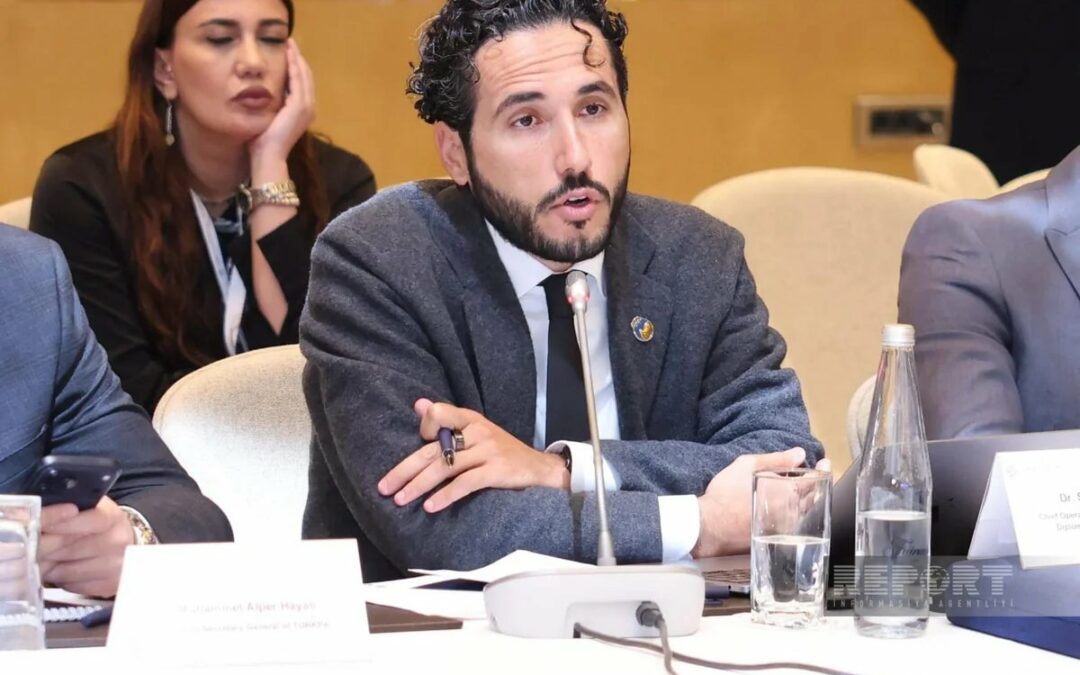
Will AI redraw the global balance of power, or harden the one we already have? The answer depends less on new rules than on whether governments, especially small and middle-sized ones, build the capacity to use the rules that exist. Reflections from the International Conference on Cyber Diplomacy in Baku.
By Dr. Sïmon Saneback, Chief Operating Officer, Tech Diplomacy Global Institute
On Thursday morning in Baku, the opening panel of the second International Conference on Cyber Diplomacy turned to the question that sits under every AI debate in foreign policy. Ambassador Elman Abdullayev, who moderated, put it to me directly: will artificial intelligence fundamentally change the global balance of power, or will it mostly reinforce the inequalities we already have? And is there anything in it for small and middle-sized countries?
The day had opened with General Musayev stressing the importance of multilateral dialogue, and that is the right starting point. No country can secure cyberspace, or govern AI, and one day superintelligence, on its own. But my answer began with an observation that makes rooms like that one slightly uncomfortable.
We do not have a shortage of rules for AI. By most counts more than 50 AI regulations are in force or in draft around the world. UNESCO has its recommendations on the ethics of AI. The AI Impact Summit in New Delhi produced a declaration in February. Since this summer the UN has run a Global Dialogue on AI Governance in which every government has a seat. A ministry that wants a framework can take one off the shelf.
What it cannot take off the shelf is the capacity to run one.
In September, during the UN General Assembly week, we brought ministries, diplomats and technology companies together in New York and asked them one question: what is the single thing stopping governments from implementing what they have already signed? The answers came back in four words. People. Mandate. A channel to industry. And money. Not one of the four is a missing rule.
That is where the balance of power is being decided. AI is changing foreign policy in two ways at once. The first is the subject matter. Chips, cloud, data and models have become foreign policy files, and they decide jobs, security and sovereignty. The risks have changed with them. A cloned voice or a deepfake can put false words in a minister’s mouth, and the fake can spread faster than any denial. Handling that is diplomatic work now, not a job for the press office.
The second change gets far less attention: the counterpart. A handful of companies now hold capabilities that used to belong only to states. More than 90 percent of the most advanced chips are made in one place. A few providers run most of the world’s cloud. A foreign ministry, in Azerbaijan or anywhere else, now has to negotiate with companies as well as with other governments, and most ministries were never built for it. They have desks for countries, regions and treaties. Very few have a desk for a platform.
So the fuller answer to the Ambassador’s question is that power is shifting, but not only between states. Part of it is moving to the companies that build and run the technology. Whether a small or middle-sized country gains or loses in that shift depends on what it brings to the table.
Fragmentation is part of the picture, and I do not think the honest goal is to make it disappear. No country, large or small, will own the whole technology stack. What matters is whether a country chooses its dependencies or has them chosen for it. At our New York roundtable on sovereign AI we settled on a working definition: sovereignty is the capacity to make meaningful choices about which dependencies to accept, and the credible ability to switch. Switching is expensive, which is why it has to be planned before a contract is signed, not after. A data center on your soil is not automatically a data center under your control. Local is not the same as sovereign.
Choosing well takes people. When AI lands on an official’s desk, one of two things tends to happen. The official refuses to touch it and the work drifts to a junior colleague or an outside consultant, or someone uses it without judgment and the mistake takes months to surface, because nobody senior enough can see it. In my experience it takes about a year of real practice before an institution can hold its own across the table from a technology company, and that fluency cannot be bought. A simple test for any government: how many of the people who will implement your AI commitments have actually used the technology they are meant to govern?
It also takes continuity. Too often the technology file belongs to one capable person, a minister, an envoy or an adviser, and when that person moves on the file leaves with them. Responsibility that lives in one person is not collective. It has to live in institutions, in mandates and budgets that survive an election, which is why parliaments matter here more than people think. And it takes a way to check. Smaller countries depend on AI systems they did not build and cannot inspect. A shared method to test the systems deployed in a region would give every country, not only the largest, a real say in their safety.
There is a structural gap underneath all of this. The norms on responsible state behavior in cyberspace now sit with the UN’s new permanent mechanism on ICT security. AI governance sits in a separate dialogue, and the old cyber working group never had a mandate on AI. Yet an AI system attacking a power grid is a cyber question and an AI question at the same time. The person who answers the phone at three in the morning during that incident needs a diplomatic channel that already exists, not one improvised that night. Cyber defense and AI governance have become one file. Our institutions still treat them as two.
Regions do not have to wait for New York or Geneva to close that gap, and Baku shows how. Azerbaijan’s Cyber Diplomacy Center, working with ICI Bucharest and the Institute for Development and Diplomacy, trains diplomats and cyber specialists side by side. That is the two-language capability in practice. With the Trans-Caspian fiber link, Baku is becoming a crossing point for data as well as for energy and goods, and infrastructure is influence: whoever carries the data earns a seat where the rules are written.
A region can start with three things: shared training for diplomats and cyber officials; a standing channel between cyber agencies and foreign ministries, so that when an AI-driven incident or a deepfake campaign hits, the call is already set up; and a common method to assess the systems everyone relies on. That is how small and middle-sized countries turn a seat at the table into weight at the table.
A year ago, on the sidelines of the 43rd UNESCO General Conference, the Samarkand Declaration on Tech Diplomacy was signed, the first declaration of its kind. The declaration gave tech diplomacy a commitment. What it needs now is capability, which is why tech diplomacy has moved from the edge of foreign policy toward its center, as an umbrella over cyber diplomacy, AI and the infrastructure underneath both. If I could put one new rule on the table, it would be this: every foreign ministry needs people who speak two languages, diplomacy and technology. Without them, the best framework in the world stays on paper.
We will take that message from Baku to our Global Assembly in Paris on December 11.
The rules are written. Now we need the people who can run them.