
On 12 June 2026, Brazil became the first large emerging market to sign a Digital Partnership with the European Union. This article introduces the WAT framework — diplomacy With, About, and Through technology — and shows how Brazil built tech diplomacy capacity from market scale and regulatory alignment rather than frontier innovation. The model carries direct lessons for India, Indonesia, Mexico, and other Global South states.
ORCID: https://orcid.org/0009-0002-2724-0963 | CC BY 4.0 | Download PDF.
Abstract
On 12 June 2026, Brazil and the European Union signed a comprehensive Digital Partnership covering data governance, artificial intelligence, digital infrastructure, online platforms, and digital public goods. This article uses the partnership to introduce the WAT framework (diplomacy With, About, and Through technology) and a four-pathway typology of tech diplomacy capacity: innovation-based, infrastructure-based, market-based, and standards-based. The framework broadens an innovation-centric focus in recent scholarship by showing that capacity is multi-dimensional. Brazil’s strategy leverages its 213-million-consumer market, activated by regulatory alignment with the EU through mutual data-protection adequacy, rather than proprietary technological innovation, demonstrating that large emerging markets can translate market scale and regulatory alignment into diplomatic influence. The findings have direct implications for India, Indonesia, Mexico, and other Global South states seeking to enhance their digital sovereignty and international partnerships.
Keywords: tech diplomacy, WAT framework, market-based pathway, data adequacy, Brazil–EU Digital Partnership, Global South
The partnership is the EU’s fifth Digital Partnership, following those concluded with Japan, South Korea, Singapore, and Canada. Crucially, however, it is the first such partnership the EU has signed with a large emerging market rather than an advanced economy. That distinction lies at the heart of this article’s argument.
The timing followed the mutual adequacy decisions adopted by the European Commission and Brazil in January 2026, under which each side recognized the other’s data-protection regime as providing essentially equivalent protection for personal data, the EU’s under the General Data Protection Regulation (GDPR) and Brazil’s under its Lei Geral de Proteção de Dados (LGPD) (European Commission, 2026b). These reciprocal decisions created a seamless, two-way transatlantic data corridor, enabling free data flows between Brazil and the EU and transforming data protection from a compliance burden into a diplomatic asset.
The partnership signals a strategic realignment in how tech diplomacy capacity is understood and exercised. Brazil is not a traditional “innovation power” in the mold often emphasized by recent tech diplomacy literature. It does not export proprietary digital platforms, nor does it host a Silicon Valley-scale innovation ecosystem. But Brazil possesses deep institutional capacity in what it terms “innovation diplomacy” (Ministério das Relações Exteriores, 2023).
A terminological clarification is essential here, because the two senses of “innovation” can easily be conflated. Brazil’s innovation diplomacy refers to an institutional tradition, the diplomatic machinery for scientific and technological cooperation, not to the generative dimension of innovation power, the capacity to produce and export frontier technology on which the literature’s flagship cases turn. Brazil’s comparative advantage does not lie in generating frontier technology; it lies in the institutional capacity, regulatory alignment, and market scale that its innovation-diplomacy apparatus can now be redirected to serve.
That apparatus is formidable. The Ministry of Foreign Affairs has maintained science and technology sections (SECTEC) in 69 embassies and consulates worldwide, forming one of the most extensive STI diplomatic networks in the world (Ministério das Relações Exteriores, 2023). Brazil’s institutional capacity in innovation diplomacy has deep roots. The formalization of science and technology cooperation within the Ministry of Foreign Affairs dates to the 1970s, when the National Council for Scientific and Technological Development (CNPq) began coordinating international S&T agreements alongside Itamaraty (Ferreira & Alarcón, 2021). By the 1980s, Brazil had established dedicated science sections in key embassies, making it one of the first developing countries to institutionalize science diplomacy as a core foreign policy function (Milani & Pinheiro, 2017; see also Royal Society & AAAS, 2010, on the broader emergence of science diplomacy as statecraft). This legacy infrastructure provided the institutional foundation for Brazil’s pivot toward technology governance in the 2020s. On 8 October 2025, Brazil appointed Ambassador Eugênio Vargas Garcia, a scholar of artificial intelligence and international relations in his own right (Garcia, 2019; Garcia & Yamakage, 2024), as its first Extraordinary Ambassador for Technology and Innovation through Ministerial Ordinance MRE No. 621 (Ministério das Relações Exteriores, 2025), formalizing a strategic pivot toward technology governance alongside its longstanding focus on scientific cooperation. Brazil’s tech diplomacy capacity is thus rooted in a large consumer market, regulatory alignment with the EU, geopolitical positioning as a bridge to Latin America, and decades of accumulated institutional experience in innovation diplomacy.
This article introduces the WAT framework, a new analytical tool for mapping tech diplomacy across three registers: diplomacy With technology (engagement with ecosystems), About technology (negotiation of rules and norms), and Through technology (deployment of technological assets as diplomatic instruments). The WAT framework builds on earlier attempts to map tech diplomacy’s dimensions (Moore Aoki, 2026), refining the distinction between About (governance), With (engagement), and Through (technological assets) to provide greater analytical precision for institutional design. Using this framework, a four-pathway typology of tech diplomacy capacity is developed, demonstrating how Brazil’s market-based pathway offers a replicable model for other large emerging economies.
The Limits of an Innovation-Centric Lens
Tech diplomacy is a growing field. Since Denmark appointed the world’s first “tech ambassador” in 2017, roughly 20 states have followed, from France (2018) and Switzerland (2021) to Kenya (2024) and Brazil (2025) (Grottola, 2026; Manor, 2025). Scholarship has developed alongside this institutional growth, with recent work by Manor (2025), Grottola (2026), and Bjola and Kornprobst (2025) mapping the emerging domain.
Much of this work is organized around the concept of innovation power. Bjola and Kornprobst (2025) define it as the capacity of states to innovate, regulate, and integrate transformative technologies within diplomatic and governance frameworks, and distinguish tech diplomacy, grounded in innovation power, from digital diplomacy (information power) and science diplomacy (knowledge power). The empirical cases that anchor this literature are predominantly frontier-technology producers: the United States (Big Tech, AI, cloud), China (digital platforms, state-directed AI), and innovation-rich states such as Taiwan (TSMC, which produces over 90% of the world’s most advanced chips; Liu, 2026), South Korea, the UAE, and France.
This concentration shapes which states are most legible within the framework. On this reading, tech diplomacy capacity tracks the generative dimension of innovation power, the ability to produce and export frontier technology. States whose comparative advantages lie instead in infrastructure control, market scale, or regulatory alignment are less readily situated, and the experiences of large emerging markets in particular remain comparatively underexamined. The literature itself notes this: the introduction to the field’s first dedicated special issue observes that an innovation lens should not come at the expense of less innovation-rich states (Bjola & Kornprobst, 2025). This article takes up that observation, proposing a framework that specifies the alternative pathways available to such states and the institutional designs each implies, and using Brazil’s June 2026 Digital Partnership to show that market-based leverage can generate partnerships of genuine strategic significance.
The WAT Framework: A New Analytical Tool
To capture the diversity of tech diplomacy pathways, this article proposes the WAT framework, an analytical tool that distinguishes three registers of diplomatic engagement with technology.
Two points of clarification distinguish WAT from existing frameworks. First, WAT operates at a different analytical level from the power-based triad of Bjola and Kornprobst (2025). Their triad classifies types of diplomacy by their underlying power resource (information, innovation, knowledge); WAT instead classifies registers of engagement that any state may combine, regardless of its power base. Second, the WAT registers should not be confused with the four pathways developed later in this article. The registers (With, About, Through) describe modes of diplomatic action; the pathways (innovation, infrastructure, market, standards) describe the underlying assets a state brings to bear. The relationship between them is generative: a state’s assets determine which registers it can credibly deploy and how strongly. Innovation assets power the Through register through exportable technology; market assets power it through conditional market access; and so on.
With Technology: Engagement With Ecosystems
Diplomacy with technology refers to engagement directed toward technology actors, ecosystems, and innovation networks. Examples include tech ambassadors and innovation attachés posted to Silicon Valley, Shenzhen, Tel Aviv, or Berlin; diplomatic delegations to major tech conferences (Web Summit, Mobile World Congress, VivaTech, CES); government partnerships with accelerators, venture funds, and research labs; and bilateral science and technology agreements facilitating researcher mobility.
The goal of with-technology diplomacy is attraction, intelligence-gathering, and network-building. It ensures that national actors have access to frontier innovation, investment flows, and emerging technological trends.
About Technology: Negotiation of Rules and Norms
Diplomacy about technology concerns the negotiation, contestation, and diffusion of governance frameworks for emerging technologies. Examples include AI ethics and safety standards at UNESCO, the OECD, and the UN; data-flow rules at the WTO and in bilateral trade agreements; cybersecurity norms at the UN Group of Governmental Experts (GGE) and Open-Ended Working Group (OEWG), whose emergence has been traced in detail by Maurer (2011); and content-moderation and platform-accountability discussions such as the EU Digital Services Act and the G7 Hiroshima AI Process.
The goal is rule-shaping, agenda-setting, and norm diffusion. It influences the international architecture within which technology is governed.
Through Technology: Deployment of Assets as Instruments
Diplomacy through technology involves the exercise of diplomatic influence via concrete technological assets or capabilities. This register most directly reveals tech diplomacy capacity, because it requires tangible resources that can be deployed strategically.
The United States exemplifies a distinctive form of influence through technology rooted in its concentration of globally dominant tech companies. Although these firms are nominally private, they operate under US jurisdiction and are subject to export controls and national security directives. On 12 June 2026, the day the Digital Partnership was signed in Brasília, the US government issued an export-control directive suspending all access to Anthropic’s most advanced AI models, Fable 5 and Mythos 5, by any foreign national, whether inside or outside the United States; to ensure compliance, the company abruptly disabled both models for all customers worldwide (Anthropic, 2026a; CNBC, 2026a). Anthropic publicly contested the directive’s basis, describing it as a misunderstanding. Following weeks of negotiation between the company and the US government, the export controls were lifted on 30 June 2026, with Fable 5 restored globally on 1 July and Mythos 5 returned only to US organizations approved by the government (Anthropic, 2026b; CNBC, 2026b). The episode and its resolution alike illustrate how the US can exercise extraterritorial control through its AI ecosystem, projecting innovation power unilaterally rather than through diplomatic negotiation: both the suspension and the restoration were settled within a bilateral channel between one company and its home government, and access to the more capable model remains conditioned on government approval. The contrast with the negotiated partnership signed in Brasília the very day the directive was issued could hardly be sharper. Similar dynamics operate in cloud computing (AWS, Azure, and Google Cloud control global data flows), semiconductors (Nvidia’s advanced chips subject to export licenses), and social media platforms (content moderation policies shaped by US regulations). This structural arrangement of private innovation under public jurisdiction enables the US to project power through technology without direct state ownership and often without diplomatic engagement, a model distinct from China’s state-directed approach or the EU’s regulatory-export strategy that operates through multilateral negotiation.
Beyond the US model, examples of diplomacy through technology include China’s Belt and Road digital infrastructure (fiber-optic networks, 5G, smart cities) extending influence across Asia, Africa, and Latin America (innovation-based); Cabo Verde’s Atlantic submarine-cable hub linking Brazil, West Africa, and Europe, and Djibouti’s Red Sea cable nexus connecting Africa, the Middle East, and Asia (infrastructure-based); Brazil’s LGPD adequacy enabling a Digital Partnership with the EU and India’s Digital India initiative leveraging scale (market-based); and the EU’s GDPR as a global regulatory template and China’s cyber-sovereignty doctrine shaping digital governance in Belt and Road countries (standards-based).
The WAT framework is pathway-agnostic: it does not privilege innovation over infrastructure, or market leverage over standards exportation. Instead, it provides a diagnostic tool for mapping how different states exercise tech diplomacy capacity based on their structural advantages.
Four Pathways to Tech Diplomacy Capacity
Building on the WAT framework, four distinct pathways can be identified through which states deploy technology as a diplomatic instrument. The pathways are best understood as dominant logics rather than pure types: most states combine elements of more than one, and the market and standards pathways in particular are closely coupled, as discussed below.
1. Innovation-Based Pathway
Core asset: Proprietary technology, research excellence, innovation ecosystems
Examples: United States (Big Tech platforms, AI, cloud), China (digital platforms, AI, 5G), Taiwan (semiconductors/TSMC), South Korea (semiconductors, displays), France (AI research)
WAT profile: Strong Through (exportable tech), strong With (ecosystem engagement and attraction, the register that has driven the posting of tech ambassadors to Silicon Valley and other innovation hubs), variable About (depends on geopolitical weight)
Institutional design: Centralized tech ministries or innovation agencies manage digital exports and ecosystem promotion. For the US, coordination is distributed across the State Department, Commerce, the FTC, and the private sector. For China, it is centralized through the Cyberspace Administration and MIIT.
2. Infrastructure-Based Pathway
Core asset: Control over strategic digital infrastructure (submarine cables, internet exchange points, data centers, satellite ground stations)
Examples: Cabo Verde (Atlantic cable hub), Djibouti (Red Sea cable nexus), Panama (terrestrial and subsea crossroads)
WAT profile: Strong Through (infrastructure leverage), limited With (small domestic ecosystems), moderate About (seat at connectivity governance tables)
Institutional design: Coordination across telecom regulators, port authorities, and foreign ministries; often involves public-private partnerships.
3. Market-Based Pathway
Core asset: A large domestic consumer market, activated by regulatory alignment with a major bloc (EU, US, or regional partners). The market is the asset; regulatory alignment is the mechanism that switches it on, converting a high-friction, compliance-heavy market into a low-friction one that partners can enter without additional safeguards.
Examples: Brazil (213M consumers + LGPD–GDPR mutual adequacy), Indonesia (280M + GDPR-modeled Personal Data Protection Law, 2022), India (1.4B + Digital India framework)
WAT profile: Strong Through (conditional market access as bargaining chip), strong About (co-governance on regulation), moderate With (two-way investment flows)
Institutional design: Distributed inter-ministerial coordination across foreign affairs, data-protection authorities, justice, science and technology, communications, and economy. Market-based diplomacy simultaneously touches trade, regulation, infrastructure, and geopolitical positioning.
The market-based pathway is the demand-side mirror of the standards-based pathway. Where a standards power exports the rules (the EU writing GDPR), a market power adopts those rules to unlock access to its consumer base. The same regulation can therefore underpin two distinct pathways depending on which end of the transaction a state occupies. This is why Brazil, a standards-taker, belongs in the market category rather than the standards category: its leverage is not the rules it writes but the market those rules make accessible.
4. Standards-Based Pathway
Core asset: Exportable regulatory models and normative frameworks
Examples: EU (GDPR as global template, Digital Services Act, AI Act), China (cyber-sovereignty doctrine, Belt and Road digital infrastructure standards), US (Section 230, CLOUD Act, AI voluntary commitments)
WAT profile: Very strong About (rule-setting), strong Through (standards as geopolitical tools), limited With (ecosystems are means, not ends)
Institutional design: Strong central coordination with robust legal capacity and enforcement mechanisms (e.g., the European Commission’s DG CONNECT, China’s Cyberspace Administration).
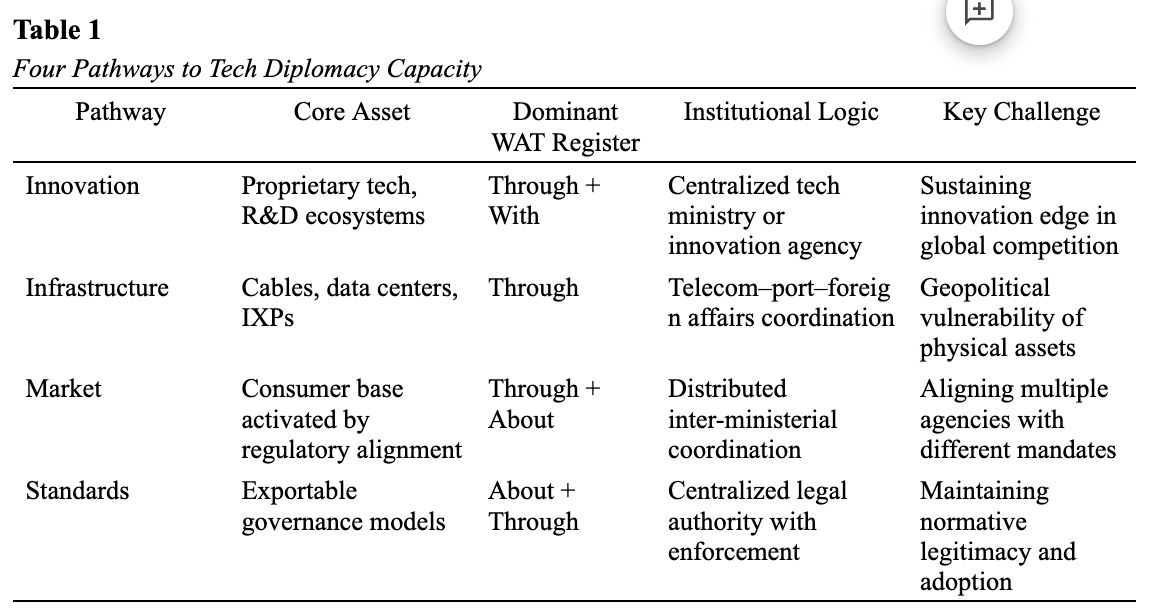
Note. With is listed where it forms part of a pathway’s dominant register mix; as the engagement register it operates across all four pathways, most visibly through the tech ambassadors and innovation attachés posted to Silicon Valley and other innovation hubs.
Brazil’s Market-Based Tech Diplomacy: Anatomy of the Digital Partnership
Brazil’s June 2026 Digital Partnership with the EU exemplifies the market-based pathway. Understanding its logic requires tracing three interconnected developments: the LGPD’s enactment and evolution, the January 2026 mutual adequacy decisions, and the partnership’s institutional architecture.
The LGPD as Strategic Asset
Brazil’s Lei Geral de Proteção de Dados (LGPD) was enacted in August 2018, closely modeled on the EU’s GDPR. The law established comprehensive rights for data subjects (access, rectification, deletion, portability), imposed obligations on data controllers and processors, and created the National Data Protection Authority (ANPD) as an independent regulator.
The ANPD became operational in 2021 and moved quickly to align its enforcement practices with European standards. By 2025, it had issued guidance on consent, legitimate interest, data transfers, and children’s data, demonstrating both technical capacity and policy convergence with the EU framework.
In January 2026, the European Commission and Brazil adopted mutual adequacy decisions, each recognizing the other’s regime as providing “essentially equivalent” protection for personal data. This was a diplomatic breakthrough: reciprocal adequacy enables seamless data flows in both directions, without requiring additional safeguards such as Standard Contractual Clauses. For European firms operating in Brazil and Brazilian firms serving European markets, the compliance burden dropped significantly.
Adequacy transformed data protection from a regulatory constraint into a diplomatic asset. Brazil could now offer European partners something tangible: a 213-million-consumer market with GDPR-compatible rules, reducing legal risk and facilitating digital trade.
Why Market Scale Is the Active Ingredient
A natural experiment within Latin America demonstrates that it is market scale, not regulatory alignment alone, that converts adequacy into a comprehensive partnership. Brazil is not the first country in the region to obtain EU adequacy. Argentina has held an adequacy decision since 2003 and Uruguay since 2012 (European Commission, 2003, 2012), and both have maintained frictionless data flows with Europe for well over a decade. Yet neither translated that regulatory alignment into anything resembling the five-pillar Digital Partnership Brazil secured in 2026. The variable that distinguishes Brazil from its smaller neighbors is not the quality or vintage of its data-protection regime but the size of the market that regime unlocks. Adequacy held by a small market produces frictionless data transfer; adequacy held by a market of more than 210 million consumers produces a strategic partnership. This contrast isolates market scale as the active ingredient and underscores why the market-based pathway is analytically distinct from the standards-based one: Uruguay and Argentina possess the standards alignment but lack the market leverage.
The June 2026 Digital Partnership: Structure and Scope
The Digital Partnership signed on 12 June 2026 builds directly on the adequacy foundation. Its scope encompasses five pillars:
- Data governance and privacy: Deepening cooperation on enforcement; developing joint guidance on emerging issues (automated decision-making, biometrics, cross-border data flows in cloud environments).
- Artificial intelligence regulation: Aligning taxonomies, risk-based frameworks, and governance mechanisms; exploring joint research on AI safety and explainability.
- Digital infrastructure and connectivity: Joint investment in fiber-optic networks, data centers, and 5G deployment across Latin America; positioning Brazil as the EU’s infrastructure partner for the region.
- Online platforms and content governance: Dialogue on content moderation, algorithmic transparency, and the applicability of the EU’s Digital Services Act (DSA) framework to Brazilian platforms.
- Digital public goods: Cooperation on open data, digital identity interoperability (linking Brazil’s Gov.br with EU standards), and e-government services.
The partnership establishes a Digital Partnership Council co-chaired by senior officials from the European Commission and Brazil’s Ministry of Foreign Affairs. Implementation proceeds through regular high-level exchanges and dedicated technical working groups, with the first meeting of the Council scheduled within 12 months of signing to provide strategic guidance and endorse a joint roadmap for cooperation.
The partnership also includes an administrative arrangement between Brazil’s ANPD and the European Commission’s services on the protection of minors online. This concrete deliverable signals operational collaboration beyond high-level political commitments.
Market-Based Leverage Mechanisms
Brazil’s negotiating position rested on three interconnected sources of leverage.
- Consumer Market Scale. With roughly 213 million people (Instituto Brasileiro de Geografia e Estatística [IBGE], 2025) and a rapidly digitizing economy, Brazil represents one of the largest growth markets for European digital services (fintech, e-commerce, cloud computing, streaming platforms, and software-as-a-service). For EU firms, regulatory alignment reduces market-entry friction and compliance costs, making Brazil an attractive destination for investment and expansion.
- Regulatory Reciprocity. The LGPD’s GDPR compatibility, now formalized through mutual adequacy, creates a regulatory reciprocity loop: Brazil offers EU firms a familiar legal environment, while the EU offers Brazil’s data-driven industries (agritech, fintech, healthtech) seamless access to European markets. This mutual benefit strengthens the incentive for sustained cooperation.
- Geopolitical Positioning. Brazil explicitly positioned itself as the EU’s digital bridge to Latin America, offering both market access and infrastructural connectivity to a region where China’s Digital Silk Road has made significant inroads through submarine cables, 5G networks, and smart-city platforms in Ecuador, Chile, and Argentina. The EU, for its part, has framed its broader digital-partnership strategy as a means of reducing technological dependence on both the United States and China, a framing that some coverage of this agreement sharpened into reducing dependence on the United States specifically. The partnership is therefore not only economic but also geopolitical, serving as a counterweight to Chinese digital infrastructure diplomacy in the Western Hemisphere.
The partnership frames Brazil as a co-governance partner, not a capacity-building recipient. The joint Council structure, technical workstreams, and reciprocal commitments signal peer-to-peer cooperation rather than a donor-beneficiary relationship. This framing matters for domestic legitimacy in Brazil and for the partnership’s replicability to other emerging markets.
Institutional Coordination: Distributed by Design
The partnership was negotiated with the involvement of multiple Brazilian agencies, each with distinct mandates:
- Ministry of Foreign Affairs (MRE): Overall diplomatic coordination, geopolitical framing, relationship with the EU External Action Service.
- National Data Protection Authority (ANPD): GDPR alignment, adequacy maintenance, minors’ protection agreement, enforcement cooperation.
- Ministry of Science, Technology, and Innovation (MCTI): AI research collaboration, digital public goods, innovation partnerships.
- Ministry of Communications (MCOM): Digital infrastructure investments, connectivity projects, spectrum policy.
- Ministry of Finance and Ministry of Development, Industry, Trade and Services (MDIC): Trade facilitation, fintech regulation, e-commerce rules, investment promotion.
- Ministry of Management and Innovation in Public Services (MGI): Digital government policy, the Gov.br platform, and digital identity interoperability, the domestic counterpart of the partnership’s digital public goods pillar.
This distributed coordination model is often criticized as fragmented or inefficient, particularly when compared to centralized structures. But in the context of market-based tech diplomacy, distributed coordination is functional, not dysfunctional.
Market-based diplomacy touches multiple regulatory domains simultaneously: trade (market access), justice (data protection), communications (infrastructure), science and technology (AI research), and foreign policy (geopolitical positioning). No single agency possesses the mandate, expertise, or legitimacy to coordinate across all these domains. A distributed model, anchored by the Ministry of Foreign Affairs but involving specialist agencies with operational autonomy, is better suited to the multi-domain complexity of market-based tech diplomacy.
Implications for Theory, Policy, and Practice
Brazil’s Digital Partnership with the EU carries implications for how tech diplomacy is theorized, designed, and practiced.
1. Challenging the Innovation-Centric Bias
Bjola and Kornprobst’s (2025) concept of “innovation power” captures an important source of tech diplomacy capacity, but read narrowly, as frontier-technology production, it risks undertheorizing alternative pathways. Infrastructure control (Cabo Verde, Djibouti, Panama), market leverage (Brazil, Indonesia, India), and standards exportation (EU, China) represent distinct sources of diplomatic influence that do not depend on proprietary technological innovation.
Brazil’s case demonstrates that tech diplomacy capacity does not require frontier-technology production. Here the terminological distinction drawn earlier matters: Brazil is institutionally rich in innovation diplomacy yet exercises a pathway that does not rest on the generative dimension of innovation power. States that lack globally competitive tech firms or world-leading research ecosystems can still exercise significant diplomatic influence through technology if they leverage their comparative advantages strategically.
2. Institutional Design Must Follow Strategic Pathway
The four-pathway typology has direct implications for institutional design (see Table 2).
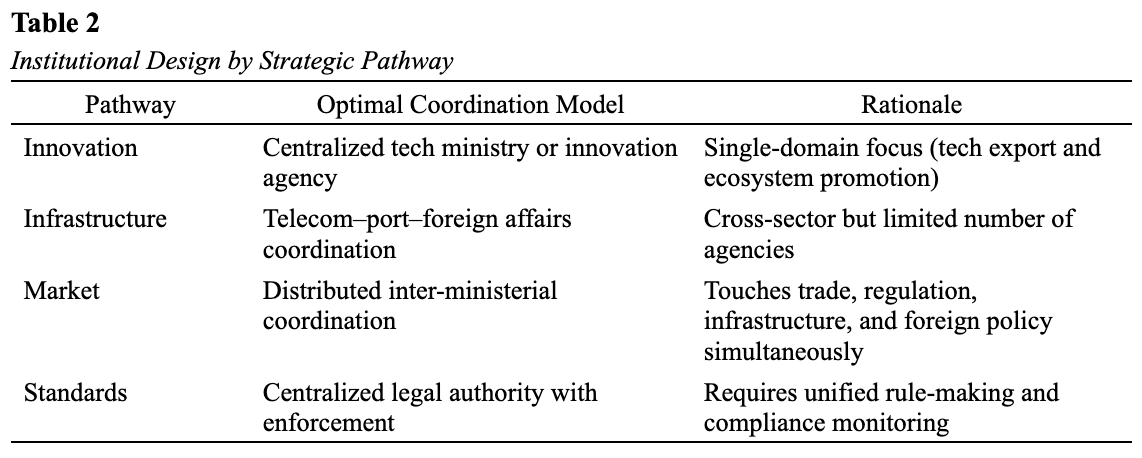
Policymakers in other large emerging markets should resist the temptation to mimic innovation-based institutional templates (e.g., creating a standalone “Tech Ambassador” office disconnected from regulatory agencies) if their comparative advantage lies elsewhere. Institutional design should align with the strategic pathway.
3. A Replicable Sequence for Emerging Markets
Brazil’s experience suggests a replicable sequence for large emerging markets seeking to translate regulatory capacity into diplomatic influence:
- Step 1: Enact a comprehensive data-protection law compatible with GDPR (or, in future, with emerging AI governance frameworks).
- Step 2: Build institutional capacity at the relevant regulatory authority and demonstrate alignment through enforcement actions, guidance, and international cooperation.
- Step 3: Seek an adequacy decision (or equivalent recognition) from the EU, US, or regional partners.
- Step 4: Leverage adequacy plus market scale to negotiate a comprehensive digital partnership covering trade, regulation, infrastructure, and geopolitical cooperation.
The clearest near-term candidate for replication is Indonesia, whose 2022 Personal Data Protection Law is explicitly modeled on the GDPR (Republic of Indonesia, 2022), and which combines a 280-million-consumer market with a central role in ASEAN digital integration, the same combination of regulatory alignment and market scale that underpinned Brazil’s success.
India presents a harder and more instructive test case. With 1.4 billion consumers and the Digital India framework, India has unrivaled market scale, but its Digital Personal Data Protection Act (Government of India, 2023) diverges from the GDPR in significant respects and New Delhi has been notably resistant to adopting EU-style data rules. India therefore tests whether market scale can substitute for regulatory alignment, or whether alignment remains a necessary precondition, a question the four-pathway model frames but cannot yet answer. Mexico offers a third variant, pairing data-protection reform with USMCA alignment and a gateway position to North American markets, suggesting that the “major bloc” a market aligns with need not be the EU.
The sequence is not automatic. Each step requires sustained political commitment, regulatory capacity, and diplomatic strategy. But Brazil’s case demonstrates its feasibility.
4. The WAT Framework as Diagnostic and Design Tool
The WAT framework offers policymakers a diagnostic tool for assessing current capacity and identifying opportunities:
- Audit current capacity: Which registers (With / About / Through) are currently active? Which are underdeveloped?
- Identify comparative advantages: Does the state have innovation assets (proprietary tech)? Infrastructure assets (cables, data centers)? Market assets (large consumer base plus regulatory alignment)? Standards assets (exportable governance models)?
- Align institutions accordingly: Does the current coordination structure match the dominant pathway?
- Explore substitution possibilities: Can regulatory alignment substitute for innovation gaps? Can infrastructure control compensate for limited market size?
For small states, the framework suggests niche strategies: infrastructure diplomacy (Cabo Verde), standards entrepreneurship (Uruguay’s software-export model), or coalition-building in multilateral About-technology negotiations.
For large emerging markets, it suggests market-based strategies: regulatory alignment as a precursor to comprehensive partnerships that span trade, infrastructure, and governance.
Limitations
The argument advanced here is subject to two limitations. First, it rests on a single case, and on a partnership whose implementation has barely begun: the first meeting of the Digital Partnership Council is scheduled only within twelve months of signature, and none of the five pillars has yet produced measurable outcomes. The claim, accordingly, is not that market-based tech diplomacy has proven durable, but that the Brazil–EU case demonstrates its feasibility as a route to a comprehensive partnership; whether the partnership delivers on its workstreams is an empirical question that only implementation will answer. Second, the four-pathway typology is derived from a limited universe of cases and should be read as a set of dominant logics subject to refinement as further digital partnerships are concluded and as comparative work on how different states institutionalize tech diplomacy matures.
Conclusion
The June 2026 Brazil–EU Digital Partnership is a proof of concept for market-based tech diplomacy. It demonstrates that states lacking dominant innovation ecosystems can nonetheless exercise significant diplomatic influence through technology, provided they strategically leverage their comparative advantages. As the EU’s fifth digital partnership but its first with a large emerging market, the agreement also marks the moment at which the EU’s digital-partnership instrument moved beyond the circle of advanced economies.
The WAT framework (diplomacy with, about, and through technology) offers an analytical tool to map this diversity. Innovation, infrastructure, market scale, and standards exportation represent four distinct pathways to tech diplomacy capacity, each with its own institutional logic and strategic requirements.
As tech diplomacy matures, the field must move beyond innovation-centric models and recognize the plurality of pathways available to states with different structural endowments. Brazil’s experience offers a roadmap for other large emerging markets and a reminder that tech diplomacy capacity is not a monopoly of the Global North.
The next wave of digital partnerships (Indonesia’s ASEAN connectivity strategy, India’s regulatory diplomacy, Mexico’s North American digital integration) will test whether Brazil’s market-based model is an outlier or a harbinger of a broader shift in how tech diplomacy is understood and practiced.
Policy TakeawaysExit Visual Builder
- A digital partnership can be designed as a capacity-building instrument, not only a trade or standards agreement: Brazil converted market scale and regulatory alignment into a comprehensive partnership without possessing frontier-technology assets.
- Mutual data-protection adequacy is a strategic asset rather than a compliance formality: the LGPD’s alignment with the GDPR became the activation mechanism for the EU’s first Digital Partnership with a large emerging market.
- For Global South states, the market-based pathway offers a replicable sequence: enact GDPR-compatible rules, build enforcement credibility, secure adequacy, and then leverage market scale into a comprehensive digital partnership.
Further reading
- European Commission, EU and Brazil deepen ties through Digital Partnership (press release, 12 June 2026): https://ec.europa.eu/commission/presscorner/detail/en/ip_26_1350
- European Commission, EU–Brazil data adequacy agreement (press release, 27 January 2026): https://ec.europa.eu/commission/presscorner/detail/en/ip_26_229
- Royal Society & AAAS, New Frontiers in Science Diplomacy (2010): https://royalsociety.org/news-resources/publications/2010/new-frontiers-science-diplomacy/
- Moore Aoki, https://tdgi.org/publications/from-diplomacy-about-technology-to-diplomacy-through-technology-a-three-dimensional-framework-for-tech-diplomacy/
Acknowledgments: The author thanks Ambassador Eugênio Vargas Garcia for generous conversations on Brazil’s technology diplomacy, Dr. Tawfik Jelassi for his guidance as doctoral supervisor, and Sïmon Saneback, doctoral candidate at Ecole des Ponts Business School, for comments on an earlier draft. Any remaining errors are the author’s own. The views expressed are solely those of the author and should not be attributed to the individuals acknowledged or to their institutions.
Disclosure statement: The author declares no competing interests. This research received no external funding. The author is affiliated with the Tech Diplomacy Global Institute, publisher of this article. The author used an AI assistant (Claude, Anthropic) for editorial and reference-checking assistance; all analysis, arguments, and conclusions are the author’s own.
References
Anthropic. (2026a, June 12). Statement on the US government directive to suspend access to Fable 5 and Mythos 5. https://www.anthropic.com/news/fable-mythos-access
Anthropic. (2026b, June 30). Redeploying Claude Fable 5. https://www.anthropic.com/news/redeploying-fable-5
Bjola, C., & Kornprobst, M. (2025). Studying tech diplomacy: Introduction to the special issue on tech diplomacy. Global Policy. https://doi.org/10.1111/1758-5899.70035
CNBC. (2026a, June 12). Anthropic disables access to Fable 5 and Mythos 5 to comply with government directive. https://www.cnbc.com/2026/06/12/anthropic-disables-access-to-fable-5-and-mythos-5-to-comply-with-government-directive.html
CNBC. (2026b, June 30). Anthropic says Trump admin has lifted export controls on Claude Fable 5 and Mythos 5. https://www.cnbc.com/2026/06/30/anthropic-says-trump-admin-has-lifted-export-controls-on-claude-fable-5-and-mythos-5.html
European Commission. (2003). Commission Decision 2003/490/EC of 30 June 2003 pursuant to Directive 95/46/EC of the European Parliament and of the Council on the adequate protection of personal data in Argentina. Official Journal of the European Union, L 168, 19–22.
European Commission. (2012). Commission Implementing Decision 2012/484/EU of 21 August 2012 pursuant to Directive 95/46/EC of the European Parliament and of the Council on the adequate protection of personal data by the Eastern Republic of Uruguay with regard to automated processing of personal data. Official Journal of the European Union, L 227, 11–14.
European Commission. (2026a, June 12). EU and Brazil deepen ties through Digital Partnership [Press release]. https://ec.europa.eu/commission/presscorner/detail/en/ip_26_1350
European Commission. (2026b, January 27). EU–Brazil data adequacy agreement [Press release]. https://ec.europa.eu/commission/presscorner/detail/en/ip_26_229
Ferreira, F., & Alarcón, C. (2021). Science diplomacy and public institutions in Latin America: Current landscape and room for development. Issues in Science and Technology, 37(3), 52–58.
Garcia, E. V. (2019). The militarization of artificial intelligence: A wake-up call for the global south. Cadernos de Relações Internacionais, 1(2), 38–52.
Garcia, E. V., & Yamakage, S. (Eds.). (2024). AI IR: Charting international relations in the age of artificial intelligence. Springer.
Government of India. (2023). The Digital Personal Data Protection Act, 2023 (No. 22 of 2023). Ministry of Law and Justice.
Grottola, S. P. (2026). Tech diplomacy as experimentalist governance. Springer VS. https://doi.org/10.1007/978-3-658-50660-5
Instituto Brasileiro de Geografia e Estatística. (2025). Estimativas da população residente no Brasil e unidades da federação [Estimates of the resident population in Brazil and federative units]. https://www.ibge.gov.br/estatisticas/sociais/populacao/9103-estimativas-de-populacao.html
Liu, R. C. (2026). Beyond the silicon shield: Taiwan’s semiconductor GVCs and emerging tech diplomacy. In C. Golley, N. Farrelly, P. J. Buckley, L. Song, & W. Zheng (Eds.), China: The next phase (pp. 59–83). ANU Press.
Manor, I. (2025). A “Tech First” approach to foreign policy? The three meanings of tech diplomacy. Global Policy. https://doi.org/10.1111/1758-5899.70023
Maurer, T. (2011). Cyber norm emergence at the United Nations: An analysis of the activities at the UN regarding cyber-security. Belfer Center for Science and International Affairs, Harvard Kennedy School.
Milani, C. R. S., & Pinheiro, L. (2017). The transformation of Brazilian foreign policy in science, technology and innovation. Revista Brasileira de Política Internacional, 60(2), Article e007. https://doi.org/10.1590/0034-7329201700207
Ministério das Relações Exteriores. (2023). Diplomacia da inovação [Innovation diplomacy]. https://www.gov.br/mre/pt-br/assuntos/ciencia-tecnologia-e-inovacao/diplomacia-da-inovacao
Ministério das Relações Exteriores. (2025). Embaixador Eugênio Vargas Garcia [Ambassador Eugênio Vargas Garcia]. https://www.gov.br/mre/pt-br/composicao/secretaria-de-promocao-comercial-ciencia-tecnologia-inovacao-e-cultura/departamento-de-ciencia-tecnologia-propriedade-intelectual
Moore Aoki, A. (2026). From diplomacy about technology to diplomacy through technology: A three-dimensional framework for tech diplomacy. Zenodo. https://doi.org/10.5281/zenodo.19254226
Republic of Indonesia. (2022). Law No. 27 of 2022 on Personal Data Protection.
Royal Society & AAAS. (2010). New frontiers in science diplomacy: Navigating the changing balance of power. https://royalsociety.org/news-resources/publications/2010/new-frontiers-science-diplomacy/