
© Evelyn Hockstein / Reuters
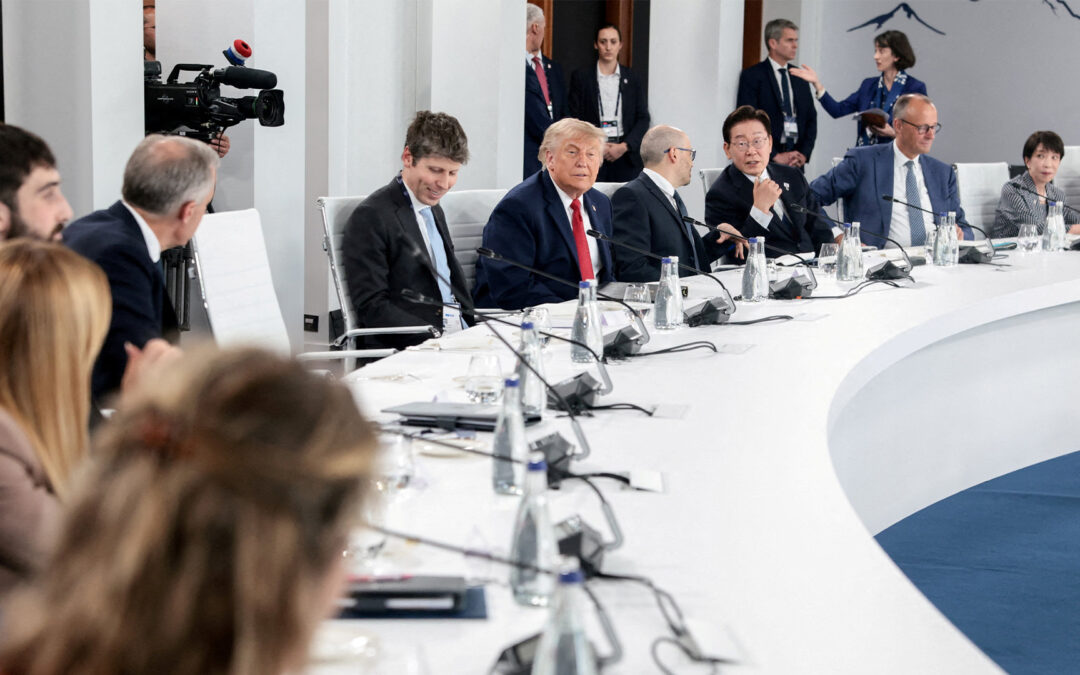
Around a table in the French Alps, on June 17, 2026, the leaders of the Group of Seven sit alongside the chief executives of the world’s most powerful artificial intelligence laboratories. Sam Altman. Dario Amodei. Demis Hassabis. Arthur Mensch. A dozen others. Joining them as outreach partners were the leaders of Brazil, Egypt, India, Kenya, and the Republic of Korea. Together, for the first time in history, all sat at the same table as presidents and prime ministers, not as witnesses, not as petitioners, but as participants in a conversation about the governance of artificial intelligence, the architecture of geopolitical power, and the shape of what comes next.
If anyone was still asking whether tech diplomacy matters, they need not ask again.
A Different Kind of Summit
What happened in Évian was not, at its core, a story about artificial intelligence. It was a story about who holds power, who sits at the table when the future is being discussed, and what it means for diplomacy when the most consequential decisions of an era are no longer the exclusive province of states.
For years, those working in the field of tech diplomacy have argued precisely this point, often against considerable institutional resistance. Foreign ministries shaped by centuries of state-to-state practice do not readily accommodate the idea that a country might need a dedicated ambassador to engage technology companies rather than governments. The argument was met, in many quarters, with polite scepticism dressed up as procedural caution. Was this not the work of trade officials? Of science attachés? Of people who could simply be attached to existing embassies with a slightly updated job description?
Évian settled that argument. When the Élysée Palace formally convened the CEOs of frontier AI laboratories at the same working lunch as G7 heads of state, it acknowledged what practitioners have long understood: that the companies building the systems that govern information, infrastructure, economic life, and increasingly national security hold a form of power that diplomacy can no longer pretend to conduct around. As one senior diplomat observed on the margins of the summit, heads of state now need the cooperation, and in some cases the endorsement, of a small number of technology executives to make credible commitments on artificial intelligence. That is not a diminishment of governments. It is a description of the world they are governing.
What Was Said, and What Was Not
The working lunch in Évian took place behind closed doors, under the formal theme of ensuring a safe, rapid, and effective deployment of artificial intelligence. What emerged through diplomatic channels was instructive. Anthropic’s Dario Amodei and Google DeepMind’s Demis Hassabis called for a US-led international coalition to shape the rules and standards around AI, a framing that sat uneasily with European delegations already anxious about exactly that prospect.
Their anxiety had a concrete recent cause. Days before the summit, the Trump administration had suspended foreign access to some of Anthropic’s most advanced models, citing national security concerns. The decision sent what one French official described as shockwaves through European capitals, confirming a fear that had been circulating for months: that European governments rely on AI infrastructure over which they have no ultimate control, and over which the United States holds, as some put it, a potential kill switch. Marie-Anne Regnier of the French government was direct: “Tech is more and more becoming a strategic asset. Europe must be able to act on its own terms.”
The European Commission had already moved in anticipation of precisely this moment, unveiling a tech sovereignty package intended to accelerate domestic AI development and reduce structural dependency on American platforms. In Évian, that project acquired a new urgency.
None of this, it should be noted, is surprising. It is the logical culmination of a trajectory that has been visible for years to anyone paying attention to the intersection of technology and geopolitics. The surprise, if there is one, is only that it took this long for the conversation to reach the summit table.
The Question That Can No Longer Be Asked
Since Denmark appointed the world’s first Tech Ambassador in 2017, not to a country, nor to an international organisation, but to an industry, establishing an office in Silicon Valley to engage directly with technology companies, the field of tech diplomacy has struggled with a particular kind of institutional scepticism. It is the scepticism reserved for things that seem obvious in retrospect but are inconvenient in the present: the suggestion that technology companies had become actors of geopolitical significance requiring sustained, expert diplomatic engagement rather than the occasional regulatory complaint.
That scepticism has not disappeared entirely. But it has become very difficult to sustain in front of the Évian photograph.
When the chief executives of OpenAI, Anthropic, and Google DeepMind sit at a table with the leaders of France, the United States, Germany, the United Kingdom, Canada, Italy, and Japan, and when the subject of conversation is not a trade dispute or a bilateral agreement but the future governance of artificial intelligence and its implications for global order, the case that technology is a peripheral concern for diplomacy has not merely weakened. It has collapsed.
What Came Out of Évian
The headline image came from a working lunch. The formal outcomes came from the leaders’ track.
G7 leaders, joined by partner countries including India, Kenya, South Korea, Brazil, and Egypt, adopted nine declarations across the summit, on Ukraine, migration, drug trafficking, critical minerals, growth, and several other areas (Élysée, 2026). On digital and AI specifically, leaders committed to working with leading companies “to accelerate the safe and beneficial deployment of AI for society,” and issued a separate joint statement, alongside outreach partners, calling for a safer digital space for minors, with explicit reference to chatbot risks and synthetic child sexual abuse material (Élysée, 2026; Euronews, 2026). G7 digital ministers had laid groundwork for the online safety statement at a Paris meeting in late May, agreeing shared principles on age verification and related risks for minors (Euronews, 2026).
No new binding AI treaty, regulatory body, or enforcement mechanism emerged from the AI lunch itself. What emerged, and what will outlast this single summit, was the precedent: that the leaders of the world’s leading industrial democracies now treat a sustained, table-level conversation with frontier AI company chief executives as a normal and necessary part of summit business, alongside critical minerals, migration, and macroeconomic coordination.
That precedent is the lasting outcome.
References
Élysée. (2026, June 17). The outcomes of the Évian G7 Summit. https://www.elysee.fr/en/g7evian/2026/06/17/the-outcomes-of-the-evian-g7-summit
Euronews. (2026, June 17). Six takeaways from the G7 Summit in Évian. https://www.euronews.com/my-europe/2026/06/17/six-takeaways-from-the-g7-summit-in-evian
France 24. (2026, June 17). AI and tech sovereignty top last day of G7 Summit in Évian. https://www.france24.com/en/ai-and-tech-sovereignty-top-last-day-of-g7-summit-in-evian
France24 (2026, June 17). Six takeaways from the G7 Summit in Évian [reposted under attribution]. Euronews.
Moore Aoki, A. (2026). From diplomacy about technology to diplomacy through technology: A three-dimensional framework for tech diplomacy. Tech Diplomacy Global Institute. https://doi.org/10.5281/zenodo.19254226