
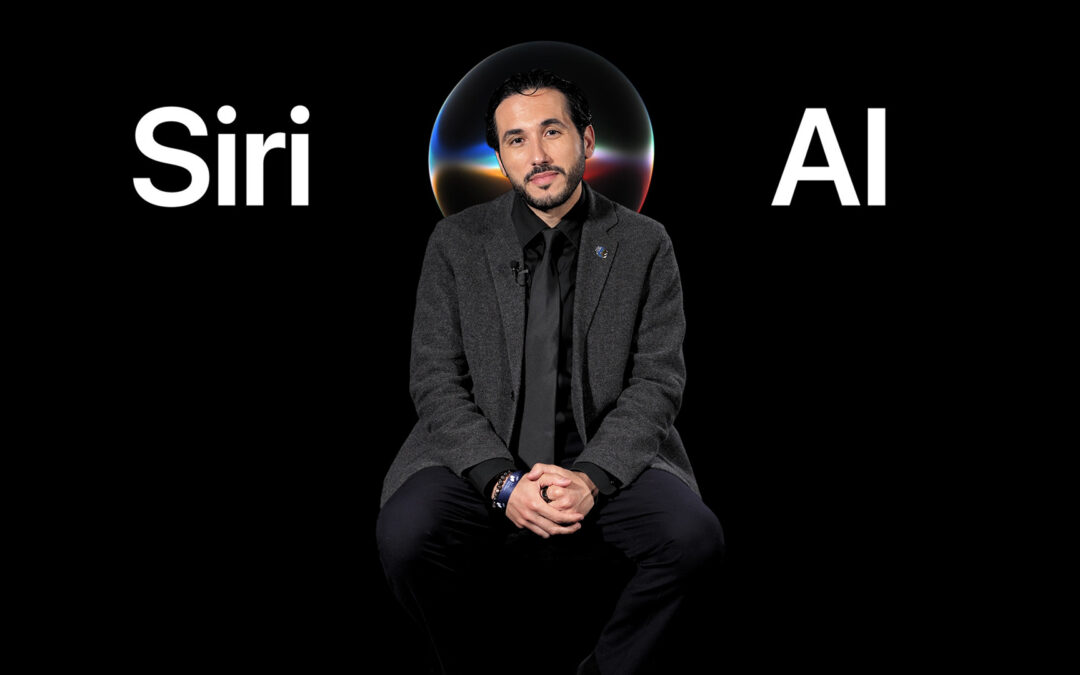
The standoff between Apple and Brussels over Siri AI is not a story about a delayed feature. It is the first great standoff of the agent era, and a preview of a world that has engineers and regulators but no negotiators.
By Sïmon Saneback, Chief Operating Officer, Tech Diplomacy Global Institute
It took seventy-two hours in June to show the world what a missing profession looks like.
On Monday, June 8, at its developer conference in Cupertino, Apple unveiled Siri AI, the most ambitious reinvention of its assistant in a decade. And then, at the end of all that excitement, came a small disclaimer delivered onstage: Siri AI would not be shipping on iPhones and iPads in the European Union. A newsroom post the same day filled in the details, blaming the Digital Markets Act and regulators who, in Apple’s words, refused to engage constructively. On Tuesday, the European Commission took to its own podium: the decision was “Apple’s and Apple’s only,” because nothing in the DMA prohibits launching new features in Europe. On Wednesday, the Commission’s spokesperson pressed the point with a video on his social channels, and the dispute between a three trillion dollar company and the regulator of a 450 million person market was now being conducted through dueling press releases and social media.
Strip away the heat and look at what was actually in dispute. Apple proposed an intermediary architecture, a Trusted System Agent, plus a staged eighteen-month rollout. The Commission found the proposals noncompliant and the exemption request unacceptable. Underneath the legal language sits a question that is not legal at all: can third-party AI agents be granted the same access as Siri AI without compromising the privacy and security of the device? That is an empirical, testable, engineering question. And here is the remarkable thing: nobody on earth currently holds a mandate, trusted by both sides, to test it.
So a question of engineering was settled by attrition. Europeans keep an older assistant. European developers cannot build on the new one. Apple forfeits its richest overseas market for its flagship feature. The Commission spends credibility explaining that a law designed to expand choice has, for now, coincided with less of it. Nobody won, and that is the signature of a missing process, not of a wrong answer.
It matters far beyond Cupertino and Brussels, because this is the opening act of a much larger drama. Assistants answer; agents act. The systems now arriving will book, buy, negotiate, and operate across every platform boundary in our lives, and every one of those boundaries raises the same question that just deadlocked two of the most sophisticated institutions in the world: which agents may act inside your system, on whose authority, with what access, verified by whom?
Governments have noticed. Singapore published the world’s first governance framework for agentic AI in January, introducing Agent Identity Cards and graduated autonomy levels. In February, the United States launched a national standards initiative for AI agent interoperability and security, with open protocols as its baseline. The EU AI Act becomes binding on high-risk systems in August. The technical plumbing of the agent age is being standardized at speed.
But standards do not settle standoffs. A standard tells you what good looks like; it does not get two parties who distrust each other to agree that they are looking at the same thing. The DMA did not fail in June for lack of legal text, and Apple did not walk away for lack of engineering talent. What failed was the layer in between: there was no trusted channel where Apple’s safety claims and the Commission’s openness requirements could be examined together, by people with the expertise to evaluate both, before positions hardened into podiums.
Diplomacy has solved this problem before. The breakthrough of twentieth-century arms control was not trust. It was verification: inspectors, telemetry, agreed baselines, and the institutional machinery that let adversaries act on facts they could both accept. “Trust but verify” was not a slogan, it was an architecture. Ported to the agent age, that architecture looks concrete and buildable. A neutral, standing technical capacity that both platforms and regulators recognize, with the mandate and the access to assess claims like “this interoperability design exposes the user’s personal data” or, just as importantly, “this safety objection is protectionism wearing a privacy costume.” Staged rollouts with verified milestones instead of blanket exemption requests answered by flat refusals. Confidence-building measures between companies and commissions, the way we once built them between capitals.
None of that machinery exists yet for AI agents. Building it is not a job for engineers alone, who optimize for their systems, nor for lawyers alone, who optimize for their jurisdictions. It is the work of a third profession, one with its own training, its own career paths, and its own institutions, the profession this Forum and this magazine exist to build. Tech diplomacy is not a decorative layer on top of policy. It is the missing institutional layer between code and law.
The twentieth century built institutions that could verify warheads. The twenty-first has not yet built institutions that can verify a software agent. Until it does, expect more weeks like the one this June: two giants, one podium each, and no table between them.
Building that table is the work. It is why tech diplomacy exists.